- Research
- 2022-2026 Research Strategy
- Open Clinical Trials
- Closed Clinical Trials
- What is a Clinical Trial?
- Why Participate in a Clinical Trial
- Remote Telehealth Pre-Screening Process
- Research Achievements
- Publications
- Research Development and Funding
- Participating Institutions
- International Collaboration
- BCT Trials & Projects Summary
- Translational Research
- Clinical Fellowship Program
- International Fellowship Support
- Annual Scientific Meeting
- Travel Grants and Awards
- About
- Our Impact
- Fundraise
- Donate
- Researcher Login
- Cart
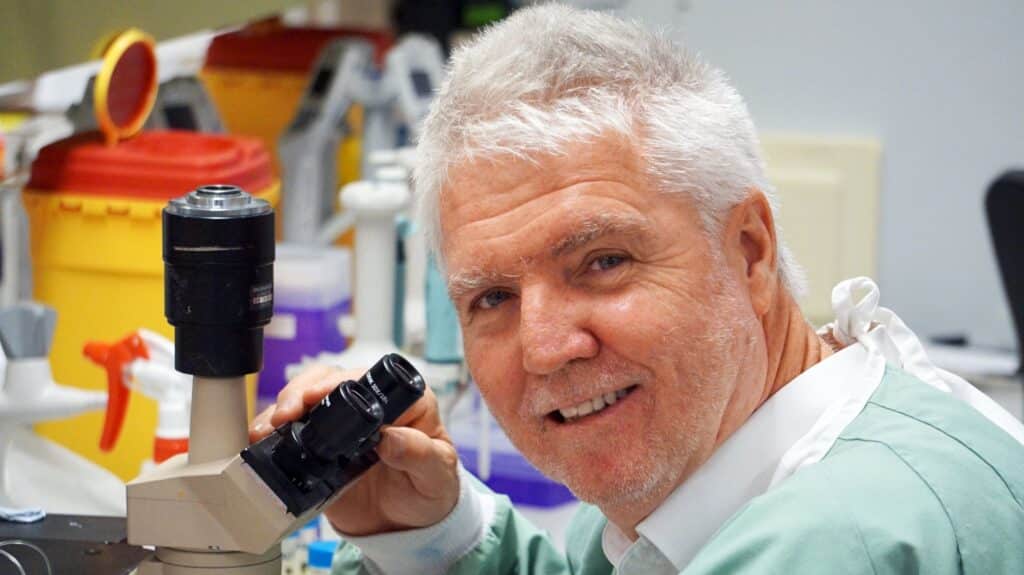
About Professor Rik Thompson
Pr Erik (Rik) Thompson graduated from Griffith University in 1978 with a Bachelor of Science with Honours, followed by a PhD in Reproductive Cell Biology in 1986.
Following his PhD, he undertook postdoctoral training in USA, at the National Institutes of Health, Bethesda MD, and then the Lombardi Cancer Centre, Georgetown University Medical Centre, Washington DC, studying invasion and metastasis of breast cancer with Drs George Martin and Marc Lippman, respectively. He became a Assistant Professor at Georgetown University Departments of Anatomy and Cell Biology, and Orthopaedic Oncology.
In 1997 he relocated to St Vincent’s Institute of Medical Research (SVI), Melbourne, Australia, as part of the newly-formed Victorian Breast Cancer Research Consortium (VBCRC), where he established the VBCRC Invasion and Metastasis Unit. He was appointed as Associate Professor of Surgery, University of Melbourne at that time, and served as Associate Director of SVI from 1998-2006. He joined the Bernard O’Brien Institute of Microsurgery, also located on the St. Vincent’s campus, from 2002-2006 as Director of Research, and was involved with research using ECM extracts in vascularised adipose tissue engineering for mastectomy reconstruction.
In 2014, he was recruited to Queensland University of Technology (QUT) as a Capacity Building Professor, and led the ‘Chronic Disease and Ageing’ Theme in the Institute for Health and Biomedical Innovation (IHBI) until 2016, when he became Associate Director of IHBI, QUT, at the Translational Research Institute (TRI). This role has been renamed Research Lead, QUT @ TRI since 2020.
His postdoctoral research sowed the seeds for an ongoing interest in mechanisms through which breast cancer progress from the breast to local (lymph node) and distant (e.g. bone) metastases, including epithelial mesenchymal plasticity (EMP), and circulating tumour cells (CTCs). He also studies the breast cancer risk associated with mammographic breast density.
Rik has played leadership roles across several fields. He cofounded The EMT International Association (TEMTIA) and co-convened their 1st meeting in Cairns, 2003, and 7th congress in Melbourne 2015.
He also convened the international congress of the Metastasis Research Society (MRS) in Brisbane in 2012, having been Board Member, Vice President, and President 2010-2012, and co-created the Australasian chapter (OzMRS) of MRS. He was also the founding president of the Australasian Microarray & Associated Technologies Association (AMATA, now Australian Genomic Technologies Association). He was on the Research Advisory Committee of the NBCF (2007-2014) and a Director for Breast Cancer Trials (2017-2019).
On the research front, Rik led the NBCF-funded EMPathy breast cancer research network (28 investigators in 20 institutions around Australia, 2010-2015), which pioneered studies on EMP in CTCs and EMP regulation, showing that MEK inhibition reversed EGF-stimulated EMT but enhanced hypoxia-induced EMT.
He led the Centre for Personalised Analysis of Cancers (CPAC; 2029-2023), generating 3D patient-derived organoid (PDO) cultures for informing treatment. Breast cancer PDOs exhibit EMP and allow study of EMP modulation effects on therapy responses.
Qualifications and Professional Experience
Professor Thompson’s qualifications and professional experience includes:
- PhD, Griffith University, QLD – looking at the cooperation between the different cell types in generation of the connective tissue (extracellular matrix) they share, and which affects their behaviour
- Postdoctoral Training, National Institute of Dental Research, Bethesda MD USA – Basement membrane invasion by breast cancer cells as a primary requirement for metastasis
- Postdoctoral Training, Lombardi Cancer Research Centre, Georgetown University Medical Centre, Washington DC, USA – Role of matrix metalloproteinases (MMPs) in breast cancer invasion of metastasis, inhibition of MMPs; role of EMT in breast cancer progression.