- Research
- 2022-2026 Research Strategy
- Open Clinical Trials
- Closed Clinical Trials
- What is a Clinical Trial?
- Why Participate in a Clinical Trial
- Remote Telehealth Pre-Screening Process
- Research Achievements
- Publications
- Research Development and Funding
- Participating Institutions
- International Collaboration
- BCT Trials & Projects Summary
- Translational Research
- Clinical Fellowship Program
- International Fellowship Support
- Annual Scientific Meeting
- Travel Grants and Awards
- About
- Our Impact
- Fundraise
- Donate
- Researcher Login
- Cart
People who have breast cancer usually have chemotherapy and then surgery, followed by more treatment with radiation therapy to their breast. This is to help stop cancer coming back later (“recurrence”). However, modern treatments are very effective. People often don’t have any invasive cancer left in the breast when they have surgery.
Recent information suggests that the risk of breast cancer coming back is very low if there is no invasive cancer found at surgery. Patients, doctors and researchers are asking the question: “Do people need to have radiation to their breast when they don’t have any invasive cancer left after chemotherapy and surgery?”.
ROSALIE is open to people who:
- Are female and 18 years of age or older
- Have breast cancer that is only in the breast (that is, has not spread to lymph nodes in the chest or the chest wall)
- Have had at least 8 weeks of chemotherapy and then surgery on your breast after chemotherapy
- Surgery found that there is no invasive cancer remaining in the breast
- Some people may have a small amount (no more than 1cm) of ductal carcinoma in situ (DCIS) remaining after treatment. DCIS is an early non-invasive form of breast cancer. DCIS remaining after treatment is called residual DCIS. You can also take part in ROSALIE if you have residual DCIS.
The ROSALIE team will review the surgery report and collect information about participants’ date of birth, race and ethnicity, general medical history, physical examination and reports from any imaging, such as mammograms.
Participants will be followed up 7 times in the clinic at the same time as your usual follow-up:
- At 6 months, 12 months and 18 months
- At 2 years
- Once per year for Years 3, 4 and 5.
People taking part can choose to complete questionnaires about how they feel about the chance of cancer coming, back, the results of their surgery, and the effects of breast cancer on their physical and mental health. They are completed 5 times:
- When they start ROSALIE (Registration)
- 6 months after registration
- 1 year after registration
- 3 years after registration
- 5 years after registration.
ROSALIE has been open in Canada since 2024. The study aims to recruit 352 participants; BCT will contribute at least 120 participants from 22 sites across Australia and New Zealand.
Please click here for further information about taking part in ROSALIE.
Please click here to listen to a podcast about ROSALIE
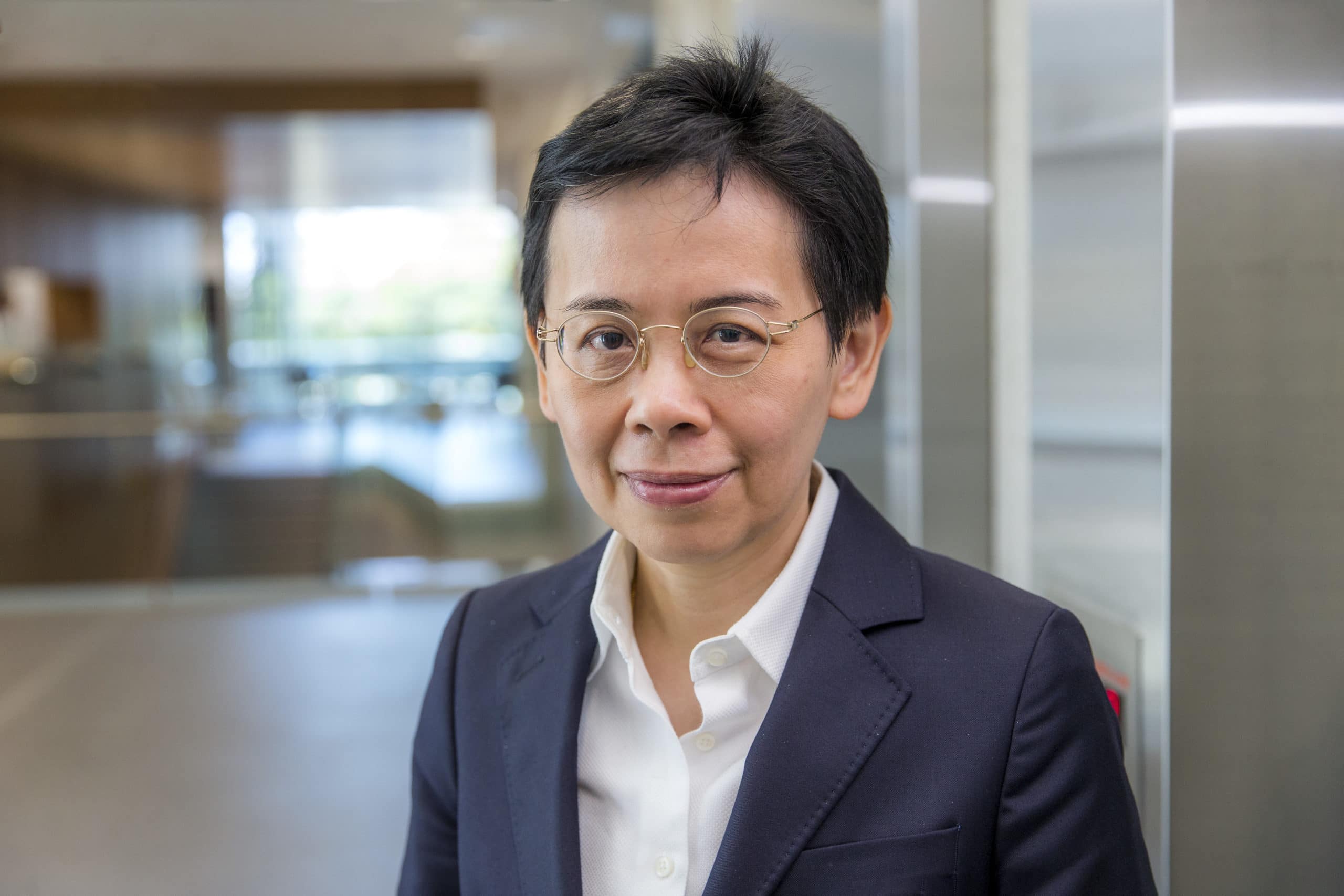
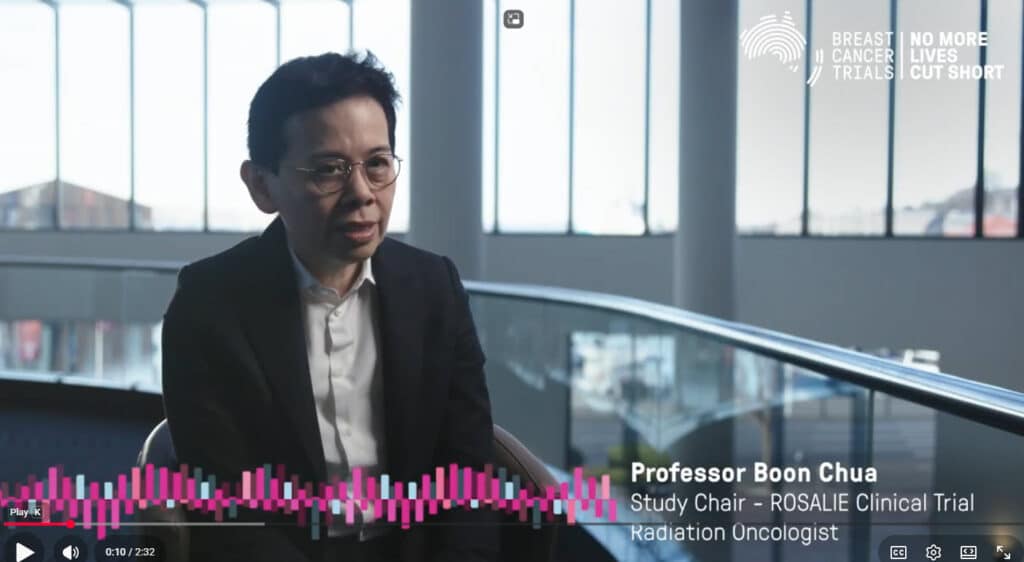
Prof Boon Chua is the Study Chair of the ROSALIE clinical trial.