
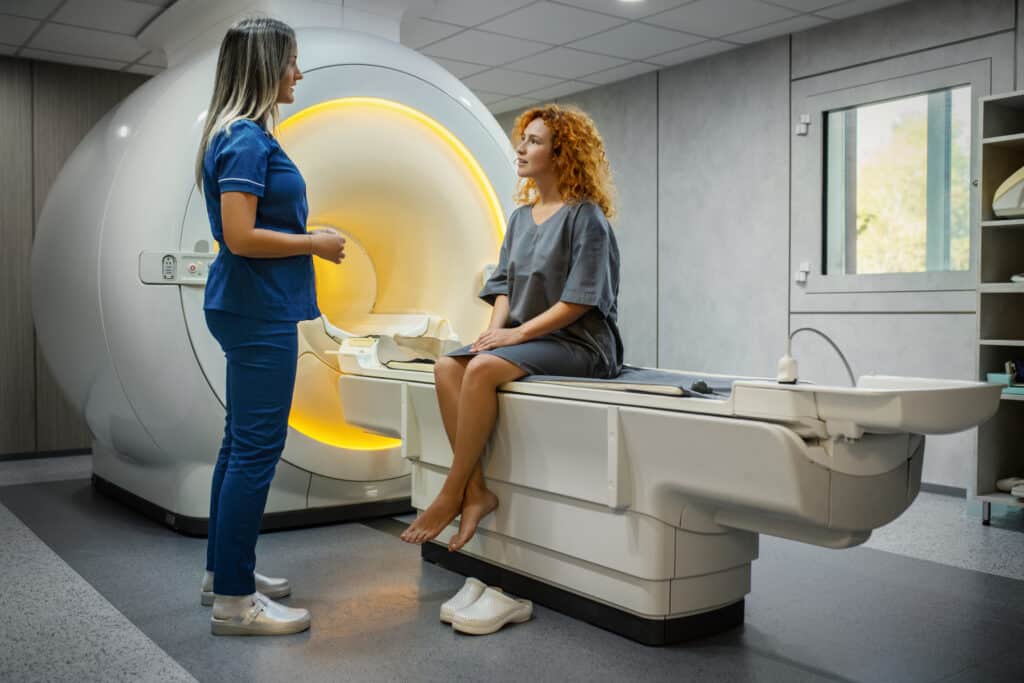
MRI Guides Better Treatment Decisions for Breast Cancer
The use of magnetic resonance imaging to examine newly diagnosed breast cancers provides valuable information that can change treatment, particularly in younger women with denser breasts, an Australian study has found.
Cancer surgeon Professor Christobel Saunders, from Royal Melbourne Hospital and the Peter MacCallum Cancer Institute, has spent years pushing for Australian women to have the option of a Medicare-subsidised MRI as part of their initial cancer diagnosis.
“It was particularly frustrating that you could get an MRI of your knee if you fell over playing football on a Saturday and have it funded, but if you had breast cancer, you couldn’t get an MRI,” Professor Saunders said.
Now Professor Saunders and colleagues have completed a prospective trial involving 387 women from across NSW, Victoria and Western Australia, all of whom had been diagnosed with breast cancer using conventional methods but who clinicians felt would also benefit from having an MRI to guide treatment.
The study, published in the Medical Journal of Australia in November 2025, showed that in just over half of cases, the information provided by the MRI led to a change in the breast cancer treatment plan.
In 31% of cases, the MRI results prompted a change in surgical strategy, many from breast conserving surgery to mastectomy. The rate of mastectomies almost doubled after the MRI results were reviewed by surgeons, from 15% of women to 28%.
“Most of that increased extent of surgery was justified, at least as far as we could tell from looking at the pathology reports,” Professor Saunders said. “In other words, the tumours were truly larger tumours or multifocal tumours.”
The study also revealed that the majority changes in surgical management occurred in women under the age of 70, which Professor Saunders says reflects the fact that older women tend to have less dense breasts that can be more clearly imaged using conventional mammograms, and who therefore aren’t likely to benefit from the additional MRI.
Another aim of the study was to examine who doctors chose to recommend for an MRI and why. Researchers saw that the most common reason for MRI was high breast density, which can make cancers harder to image using conventional methods. Other common reasons for recommending MRI were if the doctor noted a difference in tumour size from previous imaging, if the woman had multiple tumours, or if she was under 50 years of age.
Women overwhelmingly were satisfied with the additional test, which gave them greater confidence in treatment decisions, Professor Saunders said. “We hope now that the government will continue to support MRI for women newly diagnosed with breast cancer going forward.”
Publication:
Marinovich ML, Houssami N, Spillane A, Mann GB, Taylor D, Reintals M, Phillips N, Bulsara MK, Soon PSH, Dickens T, Saunders CM. Changes in patient management after preoperative MRI for newly diagnosed breast cancer: a multicentre prospective observational study. Medical Journal of Australia. 2025; 223 (11) 602-610 epub 24 Sept 2025. doi: 10.5694/mja2.70051.