
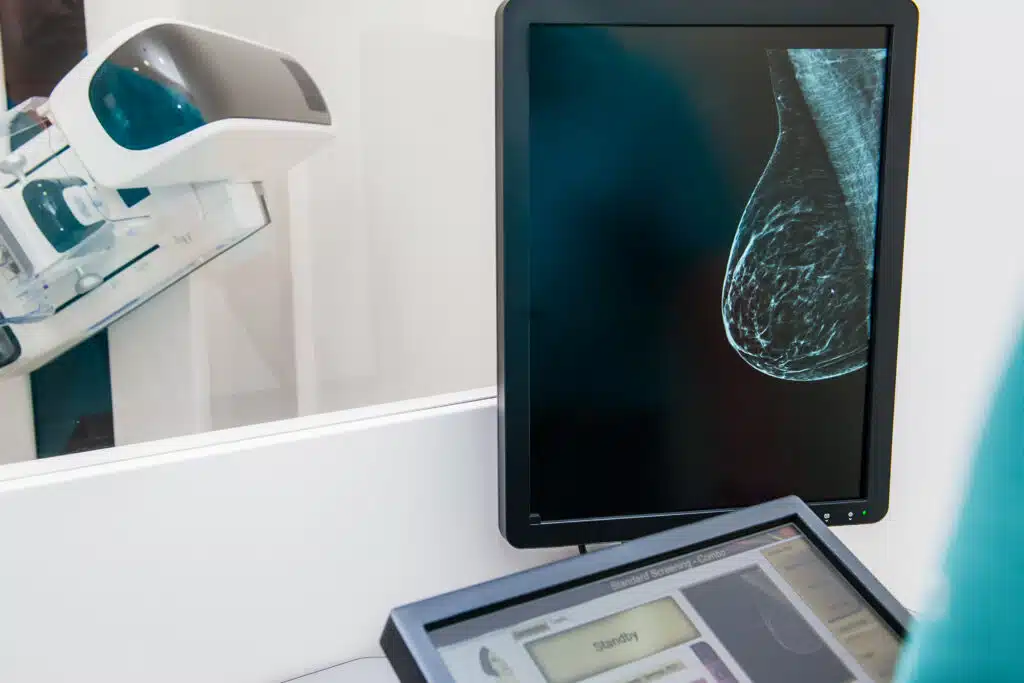
MYSCREEN TRIAL TO PERSONALISE BREAST CANCER SCREENING
07/07/2026
Breast Cancer Trials is partnering on a new pilot breast cancer screening program designed to detect cancers that develop between routine BreastScreen Australia mammograms.
Early detection of breast cancer is critical, yet 51% of breast cancers in Australia are currently diagnosed at Stage 2 or later.[i]
BreastScreen Australia (BSA) offers mammographic screening every two years, targeted to women aged 50–74, which are attended by more than half of this target group.[ii] Interval cancers (detected between screenings) represent around 23% of breast cancer diagnoses in the BSA-screened population.[iii]
The MyScreen Trial: Risk-Adjusted Breast Cancer Screening program will recruit 750 BreastScreen Victoria clients who are identified as higher risk, based on a combination of factors such as breast density and family history. They will be offered no-cost supplemental imaging through Royal Melbourne Hospital, either MRI or Contrast Enhanced Mammography, alongside routine BreastScreen care.
Higher breast density, the proportion of dense glandular tissue compared to fatty tissue in the breast, is linked to an increased risk of breast cancer and makes tumours harder to see on standard mammograms. Some state BreastScreen programs now notify women about their breast density, but there are no national guidelines.
By adjusting screening to individual risk, the MyScreen Trial aims to improve early detection for those most likely to benefit. Results from this pilot study will provide real world Australian evidence to guide future decisions about breast screening, including clearer guidance for women with higher breast density.
Currently, women aged 40–49 are eligible to attend BreastScreen Australia screenings, but they are not actively invited because the balance of benefits and potential harms of routine screening are less clear. The MyScreen Trial will include participants in this age bracket to better understand the potential of risk-based screening for this group.
The project will be spearheaded by Associate Professor Carolyn Nickson and her team from the Cancer Elimination Collaboration at the University of Sydney, with funding from the National Breast Cancer Foundation, and in collaboration with Breast Cancer Trials, BreastScreen Victoria, the Royal Melbourne Hospital and Breast Cancer Network of Australia.
Breast Cancer Trials will provide the registration platform for collecting data, monitoring data and communications throughout the trial. Professor Bruce Mann, Breast Cancer Trials’ Director of Research and Head of Breast Surgical Research, Royal Melbourne Hospital, will act as Chief Investigator on this project.
[i] National Cancer Control Indicators. (2018). Distribution of cancer stage. https://ncci.canceraustralia.gov.au/diagnosis/distribution-cancer-stage/distribution-cancer-stage
[ii] Australian Institute of Health and Welfare. (2025). BreastScreen Australia monitoring report 2025: Performance indicator 1 – Participation. https://www.aihw.gov.au/reports/cancer-screening/breastscreen-australia-monitoring-report-2025/contents/recruitment/performance-indicator-1-participation
[iii] Australian Institute of Health and Welfare. (2024). BreastScreen Australia monitoring report 2024. https://www.aihw.gov.au/reports/cancer-screening/breastscreen-australia-monitoring-report-2024/summary
Contact: BCT Media & PR Lead, Sara McGregor – 0424 591 241 or sara.mcgregor@bctrials.org.au
Our life-saving breast cancer research is only possible thanks to the continued generosity of our supporters.