
AI AND BREAST CANCER
Learn how AI is being researched in breast cancer detection, diagnosis and screening, including Australian research into AI and mammograms.
Artificial intelligence (AI) is becoming an increasingly important area of medical research, with researchers investigating how it could help improve breast cancer screening and rates of screen-detected breast cancer. AI can analyse mammogram images and identify complex patterns within them. Researchers are investigating whether this could help detect more cancers earlier which is ultimately associated with better breast cancer survival.
Australian researchers are at the forefront of this work. In 2026, results from the Australian-developed BRAIx AI system showed that AI could use information contained within mammograms to identify women at increased risk of breast cancer, including women whose mammograms had initially been assessed as clear. Using additional imaging and personalised, risk adjusted screening in these women helped detect breast cancers that would otherwise have been missed.
While developments like these are promising, AI is not replacing radiologists or the established tests used to diagnose breast cancer. Instead, research is exploring how it could work alongside healthcare professionals to improve screening and detection.
How is AI Being Used in Breast Cancer?
AI refers to computer technology that can perform tasks that would traditionally require human intelligence, such as recognising patterns and analysing complex information.
In breast cancer research, AI systems can be trained using large amounts of medical data, including mammogram images, to recognise patterns associated with breast cancer.
Researchers are exploring how AI could be used to improve breast cancer detection and screening, through the identification of women at increased risk of developing breast cancer who might benefit from additional imaging or personalised screening, or preventative therapies to reduce the risk of developing breast cancer.
AI is not currently a standard part of breast cancer detection and screening, but prospective studies about the integration of AI into routine clinical care are underway.
How Does AI Analyse a Mammogram?
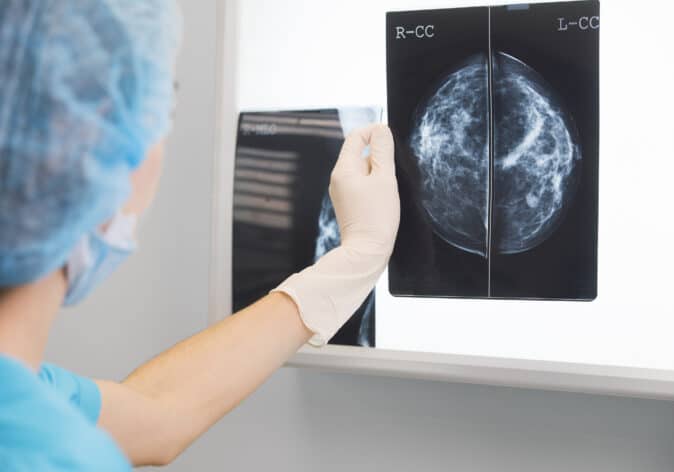
A mammogram is a low-dose X-ray of the breast that can identify changes that may be too small to feel.
When an AI system analyses a mammogram, it does not look at the image in the same way that a radiologist does. Instead, algorithms analyse patterns and features within the image based on what they have learned from large datasets of previous mammograms.
Depending on the AI system and how it has been developed, this information may be used to help identify abnormalities associated with an existing cancer or estimate a person’s risk of future breast cancer.
AI and Breast Cancer Detection
Mammography plays an important role in the early detection of breast cancer. However, like any screening test, mammography cannot detect every breast cancer.
Research into AI and breast cancer detection is investigating whether AI can assist radiologists by identifying suspicious features within mammograms that require further investigation or monitoring.
Australian research through the BRAIx project has explored different ways AI could be incorporated into population breast screening. Research published in 2024 found that some simulated approaches using AI as a second reader or for high-confidence cases improved sensitivity (the ability to detect a cancer if it is there) by between 1.9% and 2.5%, while also reducing the number of people referred for further assessment (such as more scans an biopsies).
Can AI detect breast cancer missed by a radiologist review of a mammogram?
Sometimes breast cancer is diagnosed between screening rounds after a screening mammogram has shown no signs of cancer. These are known as interval cancers.
Some may have been present but not detected at the previous screen, while others may have developed afterwards.
Researchers are investigating whether AI can identify information within a mammogram that may not be apparent to the human eye. This could include subtle signs associated with an existing cancer as well as patterns associated with an increased risk of a future breast cancer diagnosis.
This does not mean AI can find every cancer that is missed by a radiologist, on a mammogram. However, Australian research suggests it may provide additional information that could help identify some women at particularly high risk who might benefit from additional imaging or more frequent screening to detect a breast cancer.
What Did the Australian BRAIx Study Find?
BRAIx is an Australian research project investigating how AI could improve breast cancer screening.
The research is led by Associate Professor Helen Frazer, Clinical Director at St Vincent’s BreastScreen in Melbourne, and involves researchers from several Australian institutions.
In March 2026, findings from the project were published online in The Lancet Digital Health. The study investigated whether an AI cancer-detection algorithm could also be used to estimate a woman’s risk of being diagnosed with breast cancer.
Researchers developed a mammography-based BRAIx risk score, designed to predict breast cancer detection at the current screen as well as the risk of a diagnosis during the following four years.
The research used a large BreastScreen Victoria dataset of 397,648 women, which was divided into training and test datasets. The BRAIx risk score was also externally validated using data from Sweden.
The results showed that the BRAIx risk score strongly predicted both cancer detected at the initial screen and breast cancer diagnosed over the following four years.
Importantly, among women who had been given an all-clear screening result, those in the highest 2% of BRAIx risk scores had a 9.7% probability of being diagnosed with breast cancer within four years – approximately one in 10 women. This risk of cancer over the following 4 years is greater than that associated with traditional risk factors such as the high risk BRCA 1 and 2 gene mutations which have a lifetime risk of breast cancer of 65-79% for BRCA 1 mutations and 61-77% for BRCA 2 mutations.
Using the BRAIx risk score to guide screening also could have reduced the number of women without breast cancer who were required to undergo further testing meaning only those women who needed it got additional scans.
The findings show that information contained within a mammogram can estimate a woman’s risk of breast cancer now and over the next 4 years and help detect otherwise undetected breast cancers.
Could AI Help Predict Breast Cancer Risk?
There is an important difference between detecting breast cancer and predicting breast cancer risk.
Detection involves looking for signs that breast cancer may already be present. Risk prediction estimates the likelihood that someone may be diagnosed with breast cancer in the future.

A person’s breast cancer risk can be influenced by many factors, including age, family history, certain inherited genetic variants and breast density. The BRAIx research suggests information contained within a mammogram could provide another way of estimating risk.
However, AI cannot predict with certainty whether an individual will develop breast cancer. A risk score estimates probability rather than providing a definite prediction.
AI and Breast Cancer Screening and Prevention
Breast screening aims to detect breast cancer before symptoms develop.
In Australia, BreastScreen Australia provides free screening mammograms every two years to women aged 40 and over, with women aged 50 to 74 actively targeted to participate.
Researchers are investigating several ways AI could potentially support breast cancer screening. This includes assisting with mammogram interpretation and providing additional information about a person’s breast cancer risk.
Could AI Make Breast Screening More Personalised?
Population breast screening in Australia is currently primarily based on age. However, not everyone has the same risk of developing breast cancer.
Researchers are increasingly interested in risk-based screening, where a person’s individual risk could help determine the most appropriate screening approach.
In the future, people identified as being at higher risk could potentially be offered a different screening approach, such as additional scans like contrast enhanced mammography or MRI, or more frequent screening. Research such as BRAIx is investigating whether AI analysis of mammograms could contribute information that helps determine this risk.
However, AI-based risk prediction of this kind is not currently part of routine BreastScreen Australia screening. Prospective research is needed to determine how these technologies could be safely and effectively incorporated into population screening programs.
Could AI help patients access preventative treatments?
In addition to extra screening, some patients at an increased risk of developing breast cancer based on AI mammogram assessment may be offered medications to reduce this risk. These treatments do not completely prevent the development of breast cancer, but can reduce the risk by 30-50%.
Patients at an increased risk of breast cancer based on age, family history, certain inherited genetic variants and breast density are already offered these medications. AI may help identify additional patients who may benefit from this preventative strategy.
AI and Breast Cancer Diagnosis
Screening and diagnosis are two different parts of breast cancer care.
Breast screening is used to look for unsuspected breast cancer in people without symptoms. If a mammogram identifies an abnormality, further investigation is needed to determine what it is.
Depending on the circumstances, this may include additional mammograms, ultrasound and other imaging. If clinical examination or imaging identifies an abnormal area, a biopsy may be performed so cells or tissue can be examined by a pathologist to determine whether cancer is present.
Research into AI and breast cancer diagnosis is exploring whether AI can assist healthcare professionals when analysing medical images and other clinical information.
However, AI does not replace the clinical assessment and testing required to confirm breast cancer. Healthcare professionals remain central to interpreting results and determining the next steps in a person’s care.
What Are the Potential Benefits of AI for Breast Cancer?
As research continues, AI could potentially improve several aspects of breast cancer screening.
One possible benefit is supporting radiologists when interpreting mammograms. Research is investigating whether this could improve cancer detection while reducing unnecessary assessments and the number of mammograms requiring human review.
AI could also provide new ways to estimate breast cancer risk. If approaches such as BRAIx are successfully validated and implemented, this information could potentially contribute to more personalised, risk-based screening in the future.
Importantly, a system that performs well in a research study still requires careful prospective evaluation before it can become part of routine clinical practice.
What Are the Limitations of AI in Breast Cancer Care?
Despite its potential, AI is not perfect.
AI systems learn from the data used to develop them. If the data does not adequately represent the population in which the technology is eventually used, the system may not perform equally well for everyone.
AI can also make incorrect assessments. Researchers therefore need to determine not only whether an AI system works, but whether it performs reliably across different populations and healthcare settings.
There are also important considerations around patient privacy, the protection of medical data, transparency and how AI-generated information is used in healthcare decisions.
Another consideration is automation bias, where people may place too much trust in an automated recommendation. Previous BRAIx research found that automation bias could reduce mammogram-reading performance in some scenarios where a mammogram is reviewed by multiple radiologists.
These issues highlight why human oversight and careful clinical evaluation remain important when introducing AI into healthcare.
Will AI Replace Radiologists in Breast Cancer Screening?
Current research is focused largely on how AI can work alongside radiologists rather than replace them.
Radiologists bring specialist medical training, clinical knowledge and judgement to the interpretation of breast images. AI may provide additional information to support this process, but the way the two work together is important.
For example, previous BRAIx research investigated AI as a second reader of mammograms and as a high-confidence filter. These approaches showed potential to improve screening performance while reducing the number of mammograms requiring human review, by using AI to assist radiologists or identify high-confidence cases that may require fewer human readings.
The research also showed why AI needs to be introduced carefully, with the effects of human interaction with the technology considered alongside the performance of the AI system itself.
What Could AI Mean for the Future of Breast Cancer?
AI could change how information from mammograms is used in breast cancer screening.
Traditionally, mammograms have primarily been used to look for signs of breast cancer at the time of screening. Research such as BRAIx suggests that information within these images may also help estimate a person’s future risk.
If these findings are confirmed and AI tools prove safe and effective in prospective studies, this information could potentially contribute to more personalised, risk-based approaches to breast screening and prevention.
AI may also help radiologists interpret mammograms and support the efficiency of screening programs. However, careful clinical research will be essential to determine where these technologies provide meaningful benefits for patients.
For people undergoing breast screening today, AI does not replace recommended screening or medical advice. However, research underway in Australia and around the world is helping determine how AI could work alongside healthcare professionals to improve breast cancer screening and detection in the future.
Frequently Asked Questions
-
Can AI detect breast cancer?
AI can analyse mammograms for patterns associated with breast cancer. Research suggests some AI systems may help radiologists detect cancers and identify abnormalities requiring further investigation. However, AI does not replace the clinical assessment and tests required to confirm a breast cancer diagnosis.
-
Is AI currently used for breast cancer screening in Australia?
AI is being researched and evaluated for breast cancer screening in Australia, including through the BRAIx research program. AI-based BRAIx risk prediction is not currently part of routine BreastScreen Australia screening.
-
Can AI detect breast cancer earlier than a radiologist?
Research suggests some AI systems can identify information within mammograms that may assist breast cancer detection or provide information about future risk. However, this does not mean AI will consistently detect breast cancer earlier than radiologists.
Research is investigating how AI and radiologists can work together to improve screening.
-
Can AI predict who will get breast cancer?
AI cannot predict with certainty whether an individual will develop breast cancer.
Research such as BRAIx suggests that AI can analyse mammograms to estimate a person’s probability of being diagnosed with breast cancer over a particular period. This is an estimate of risk, not a definite prediction
-
Will AI replace radiologists?
Current research is exploring how AI can support radiologists rather than simply replace them. Radiologists provide specialist clinical expertise and judgement, while AI may offer additional information to assist mammogram interpretation and risk assessment.
-
Information Sources
- https://www.sciencedirect.com/science/article/pii/S2589750026000105
- https://theconversation.com/ai-could-help-us-more-accurately-screen-for-breast-cancer-new-research-277079
- https://www.breastscreen.org.au/about-us/research/case-studies/braix-transforming-breast-cancer-screening-with-artificial-intelligence-ai
- https://www.canceraustralia.gov.au/cancer-types/breast-cancer/how-breast-cancer-diagnosed/tests-breast-cancer
- https://www.nature.com/articles/s41467-024-51725-8
- https://www.thelancet.com/journals/lanonc/article/PIIS1470-2045%2814%2971171-4/fulltext
- https://www.thelancet.com/journals/lancet/article/PIIS0140-6736%2819%2932955-1/fulltext
- https://www.nsw.gov.au/health-and-wellbeing/cancer-support/breast-cancer/patient-resources/managing-your-risk-of-breast-and-ovarian-cancer
- https://www.svhm.org.au/newsroom/news/australian-ai-breast-cancer-study
Join Our Free Q&A Webinars
Don’t miss an opportunity to stay informed about the latest in breast cancer research and care. Join our FREE Q&A webinars, where we cover important topics including whether more young women are being diagnosed with breast cancer.
Stay Connected with Breast Cancer Trials
Don’t miss an opportunity to stay informed about the latest in breast cancer research and care. Sign up to our researcher’s newsletter via the form below to stay up to date.