
WHY BREAST CANCER CAN DISRUPT YOUR SLEEP
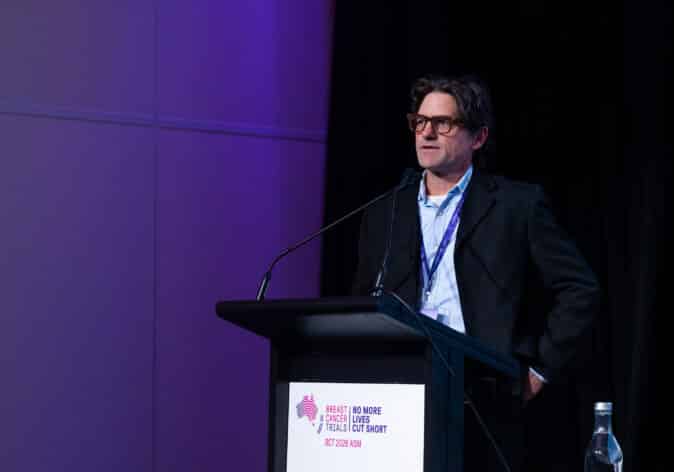
Dr Wiley discusses why sleep can be affected during a breast cancer diagnosis, the strategies that can help improve it, and what emerging research could mean for the future of cancer care.
Why Breast Cancer Can Disrupt Your Sleep & What You Can Do About It
Sleep problems are common during and after breast cancer treatment, but what impact can disrupted sleep have on recovery, wellbeing and quality of life? In this episode, we sit down with Dr Josh Wiley to explore the relationship between sleep and breast cancer.
Dr Wiley discusses why sleep can be affected during a breast cancer diagnosis, the strategies that can help improve it, common misconceptions around sleep, and what emerging research could mean for the future of cancer care.
“I’ve worked in sleep and cancer for quite a few years. Initially, they were sort of separate lines of research for me. So, I’ve come out of a lab that did work in survivorship care for cancer and then joined a research group basically that did sleep and circadian rhythms research.”
“And as I sort of learned about both of those and started learning about the prevalence of sleep problems in people with cancer, then it really became important to me to bring these together and start seeing how we can understand it and what can we can actually do to help patients sleep better.”
Why is sleep such an important part of overall health and recovery, and what are some factors that can disrupt it?
“Sleep is central to human functioning. So how we function cognitively is impacted by it, our immune system is impacted by it, there are lots of physical health markers. It’s important for overall health as well as mental health and general quality of life.”
“Sleep is not only important for many functions, but it can also be impacted by lots of factors too, which can make it quite complicated. In a breast cancer context, we know that lots of the treatments being offered to patients impact sleep.”
“There are things like surgery, which has a profound, although typically shorter-term impact on sleep, through the hospital environment often disrupts people’s routines, and can impact on symptoms and side effects.
“Nausea, pain, that sort of stuff can wake people up or make it harder to go to sleep, or once they have woken up after falling asleep, it can make it harder to return back into sleep.”
“And then you have more kind of biological components. So, we know that cancer itself and there’s some evidence that some of the tumour biology itself may impact on circadian rhythms, which can disrupt sleep. You have things like steroids; dexamethasone is a common one that has a pretty profound, or at least acute, impact on sleep.”
“So, there’s all of these things biologically, and physically in terms of routines, and then psychosocially, if the patient has a really active mind, if they’re worried about a lot of things, concerned about upcoming scans, concerned about cancer progression, concerned about what’s going to happen to your family or your career or your life, those kinds of thoughts and worries generate cognitive arousal and a degree of physical arousal that can make it really hard to fall asleep.”
“And those commonly come up as you’re trying to go to sleep because maybe during the day you’re working, you’re doing other things that kind of keep you busy, and keep you occupied. And then when you lie down to sleep at night and it’s dark, it’s quiet, there’s nothing to sort of distract you from the thoughts in your mind.”
“And the worries about sort of what’s going to happen, or what’s coming next, can stop sleep as well. So, a long answer to a simple question, but many things can unfortunately disrupt sleep. So, it becomes quite complicated.”
Listen to the podcast
In this episode, Dr Josh Wiley explores the relationship between sleep and breast cancer, including why sleep can be affected during a breast cancer diagnosis, the strategies that can help improve it, common misconceptions around sleep, and what emerging research could mean for the future of cancer care.

Key takeaways
- Sleep is a critical part of recovery, health and wellbeing: Sleep affects almost every aspect of physical and mental functioning, including immune health, cognitive performance, emotional wellbeing and overall quality of life. For people affected by breast cancer, good sleep is an important part of both treatment and recovery.
- Breast cancer and its treatments can disrupt sleep in many different ways: Sleep problems during and after breast cancer are often caused by a combination of factors. Surgery, hospital stays, pain, nausea, medications such as steroids, changes to daily routines, tumour biology and worries about diagnosis, scans, treatment and the future can all contribute to sleep disruption. This complexity means there is rarely a single cause or solution.
- Poor sleep can have far-reaching consequences: Ongoing sleep disruption is associated with higher levels of anxiety and depression, increased fatigue, reduced quality of life, poorer concentration, slower processing speed and memory difficulties. While occasional sleep disturbances are common, prolonged sleep problems can have significant impacts on both physical and mental health.
- Effective treatments for sleep problems are available: One of the most encouraging messages from the episode is that sleep problems can be treated. Dr Josh Wiley highlights cognitive behavioural therapy for insomnia (CBT-I) as the first-line treatment for many sleep difficulties. CBT-I focuses on improving sleep habits, routines and thought patterns around sleep, and can be delivered through therapists, online programs and self-management resources.
- Sleep supplements aren’t always the answer: While supplements such as melatonin and magnesium are widely discussed online, the evidence supporting many of these products is limited. Melatonin can be useful in specific circumstances, particularly for adjusting the body’s circadian rhythm, but it is not necessarily a long-term solution for chronic sleep problems. People should always discuss supplements with their healthcare team, particularly during cancer treatment.
How does ongoing sleep disruption impact physical health, mental wellbeing and quality of life for people living with or beyond breast cancer?
“There’s a good amount of cross-sectional data telling us that poor sleep and short sleep, so both kind of poor sleep quality, are associated with pretty much everything that you sort of just listed there.”
“So, there’s higher depression symptoms, higher anxiety, worse overall quality of life. It can be associated with exercise or physical kind of activity, fatigue during the day, and we know fatigue is a major other kind of symptom after cancer.”
“We have some causal evidence as well, although that data in cancer tends to be a lot more limited, where we are asking fatigue-based questions like, is it poor sleep causing limited exercise or is it limited exercise causing poor sleep? In some populations we have good evidence that sleep is causally linked to worse mental health, more intense emotions, and a harder time regulating emotions.”
“If you haven’t slept well, maybe after a long trip or things like that, you might have felt quite grumpy or if something happened it’s hard to sort of sit with it, and cognitively the emotions might feel quite intense and quite hard to come down.”
“There’s kind of mental health impacts that way. It’s harder to pay attention, processing speed is slower, memory is impaired when people don’t get enough sleep, and we have lab data to support that. And then the broader health implications do depend on the nature of the sleep.”
“If you are getting little sleep, there side effects become more profound in terms of the physical health side effects, and then there’s little disruptions to sleep as well. Our bodies are pretty good at bouncing back, but the greater the disruption and the longer-term the disruption, the more you would move away from these more transient things and move into longer term health implications.”
If there were someone listening to this podcast who was experiencing sleep problems, can these be treated, and what are some of the most effective strategies or interventions available?
“The good news with sleep is there’s a lot we can do about it. I talked about all the things that disrupt it and there are many, but likewise, that means there’s a lot that we can do to try to set it up to succeed.”
“I guess a couple simple things I would say to somebody who’s maybe experiencing sleep problems is, as much as sleep is important for us, worrying about sleep doesn’t help. So, if I’m anxious about my sleep, that’s not going to help me sleep better. In fact, it probably means as I’m trying to go to sleep, I instead start thinking about how I might not sleep well.”
“And this going to drive all these other negative consequences for me, which can make me have an even harder time falling asleep. So as much as sleep’s important, the thing I always sort of say is to set yourself up to sleep well.”
“If you’re worried about sleep, do something about it in the daytime. Once you get into the evening, it is what it is, and you’re almost kind of trying to practise acceptance with it. There’s lots of stuff that you can do, which also depends on the reason that you’re not sleeping well.”
“So, if it’s kind of a more behavioural or psychosocial something that you want to kind of personally do something about, the first line treatment really is cognitive behaviour therapy (CBT) for insomnia or at least things based on those sorts of CBT principles. This involves changing what your behaviours are around sleep, including timing, consistency and the ways that you think about sleep.”
“And so that can be quite effective. There are several programmes available now that you can use. So, there’s free online apps, there’s great self-help materials like a canned sleep booklet put out by the Peter MacCallum Cancer Centre.”
“And we’re working on a trial right now to create videos and various other self-management resources that people can use to get CBT available to hopefully as many people with cancer as possible, as well as to have therapist support.”
“If the do-it-yourself method doesn’t work, you want to also think about why you’re having those problems. If you’ve got sleep problems because of pain or steroids or something like that, then work with your healthcare team to see about how those can get managed.”
“Even if you can’t fully fix them, if you can shift some of that to different times a day, so for example let’s say you’re taking pain medication, do you want to take it when it’s most effective during the daytime? Or do you want to take it so that it’s most effective, when you’re trying to fall asleep? If that’s when you struggle, or if you’re waking up at 4:00 AM is there anything that you can do or plan to have your pain optimally managed at that point when you tend to be waking up?”
Would you recommend supplements, and if so, which ones?
“There’s lots of supplements and medications for sleep available. On the supplement end, you mentioned magnesium, melatonin; people sometimes do like valerian or things like that. And increasingly also we know there’s quite a few people who will use things like cannabis or a nightcap to fall asleep.”
“Pretty much all of these have very limited evidence for their efficacy. Many of them are safe, although there’s complexities and there can be interactions with other medications. So, it’s certainly something you should let your treatment team know about, if you are going to start taking any supplements.”
“But I would say that the evidence for most of that is limited. In terms of melatonin for really helping sleep, it’s not that strong. There’s some evidence that it can help, but in terms of the overall kind of benefit, especially after cancer, we don’t have good data on it. So, I’d be a little bit cautious about it.”
“It’s probably relatively safe, but there are some trials that have suggested some side effects and consequences of melatonin. So, I’d be kind of considerate of that. The best evidence base for melatonin is shifting the timing of when you sleep. So, for example, if you are somebody who needs to get up at 8:00 AM for work, but the way your body clock feels, you really wouldn’t want to wake up until 11:00 AM.”
“And that’s why you’re having sleep problems because your internal circadian rhythm, or your body clock, also known as when you want to be asleep vs when you want to be awake, is not aligned with whatever you need to for work, life, family, whatever it may be.”
“And in those cases, properly timed, small doses of melatonin are extremely effective at shifting people when they are asleep or awake and you don’t need very much for it, probably only half a milligram can be effective.”
“So very low doses at particular times can help with acutely falling asleep, we call it the acute hypnotic effect. So, I can’t sleep right now, can I dose myself up with melatonin to get there? Possibly. But the long-term evidence for that helping you sleep better or feel better is, is limited.”
“There’s other hypnotics as well that are prescription-based hypnotics. So, we call them ‘Z-class’ medications, zolpidem, things like that. And those can help, but they’re really not intended for long-term use.”
“All of the evidence for this sits around acute short-term use, to manage your sleep for one or two weeks. And we know a number of people get prescribed these medications, and it can be helpful. If you take steroids on one night and you’re not on steroids every day, but on the days that you take steroids you might also use a hypnotic to kind of try to balance that out. So that sort of thing is probably fine, but they’re not really approved for long term use, of around six months plus.”
If there was one piece of advice or one key message that you could give people who are affected by breast cancer and the clinicians who care for them to take away from this conversation, what would it be?
“I guess it would probably be to measure and manage sleep. So, it’s important we can assess it, and for clinicians, it’s important to ask patients about it, and understand if they’re struggling with it.”
“And for both patients and clinicians, if there are sleep problems, there’s a lot that can be done about it. Healthcare teams may have the capacity, but if not, there’s specialty sleep clinics, and there’s people doing sleep research and sleep interventions that can provide you with strategies that can help most sleep problems.”
QUICK ACCESS
Why Breast Cancer Can Disrupt Your Sleep and What You Can Do About It
Why is Sleep Such an Important Part of Overall Health and Recovery?
How Does Ongoing Sleep Disruption Impact Physical Health and Wellbeing?
What are the Most Effective Strategies and Interventions Available?
Would You Recommend Supplements and, if so, Which Ones?
What Advice Would You Give Patients and Clinicians About Sleep and Breast Cancer?

Dr Joshua Wiley
Why Breast Cancer Can Disrupt Your Sleep and What You Can Do About It
In this episode, we sit down with Dr Josh Wiley to explore the relationship between sleep and breast cancer.
 Listen On Spotify
Podcast Transcript
-
Why Breast Cancer Can Disrupt Your Sleep & What You Can Do About It
Sleep problems are common during and after breast cancer treatment, but what impact can disrupted sleep have on recovery, wellbeing and quality of life? In this episode, we sit down with Dr Josh Wiley to explore the relationship between sleep and breast cancer.
Dr Wiley discusses why sleep can be affected during a breast cancer diagnosis, the strategies that can help improve it, common misconceptions around sleep, and what emerging research could mean for the future of cancer care.
“I’ve worked in sleep and cancer for quite a few years. Initially they were sort of separate lines of research for me. So, I’ve come out of a lab that did work in survivorship care for cancer and then joined a research group basically that did sleep and circadian rhythms research.”
“And as I sort of learned about both of those and started learning about the prevalence of sleep problems in people with cancer, then it really became important to me to bring these together and start seeing how we can understand it and what can we can actually do to help patients sleep better.”
Sleep disturbances are incredibly common among people affected by breast cancer, whether during treatment or long afterwards. Why is sleep such an important part of overall health and recovery, and what are some factors that can disrupt it?
“Sleep is central to human functioning. So how we function cognitively is impacted by it, our immune system is impacted by it, there are lots of physical health markers. It’s important for overall health as well as mental health and general quality of life.”
“Sleep is not only important for many functions, but it can also be impacted by lots of factors too, which can make it quite complicated. In a breast cancer context, we know that lots of the treatments being offered to patients impact sleep.”
“There are things like surgery, which has a profound, although typically shorter-term impact on sleep, through the hospital environment often disrupts people’s routines, and can impact on symptoms and side effects.
“Nausea, pain, that sort of stuff can wake people up or make it harder to go to sleep, or once they have woken up after falling asleep, it can make it harder to return back into sleep.”
“And then you have more kind of biological components. So, we know that cancer itself and there’s some evidence that some of the tumour biology itself may impact on circadian rhythms, which can disrupt sleep. You have things like steroids; dexamethasone is a common one that has a pretty profound, or at least acute, impact on sleep.”
“So, there’s all of these things biologically, and physically in terms of routines, and then psychosocially, if the patient has a really active mind, if they’re worried about a lot of things, concerned about upcoming scans, concerned about cancer progression, concerned about what’s going to happen to your family or your career or your life, those kinds of thoughts and worries generate cognitive arousal and a degree of physical arousal that can make it really hard to fall asleep.”
“And those commonly come up as you’re trying to go to sleep because maybe during the day you’re working, you’re doing other things that kind of keep you busy, and keep you occupied. And then when you lie down to sleep at night and it’s dark, it’s quiet, there’s nothing to sort of distract you from the thoughts in your mind.”
“And the worries about sort of what’s going to happen, or what’s coming next, can stop sleep as well. So, a long answer to a simple question, but many things can unfortunately disrupt sleep. So, it becomes quite complicated.”
How does ongoing sleep disruption impact physical health, mental wellbeing and quality of life for people living with or beyond breast cancer?
“There’s a good amount of cross-sectional data telling us that poor sleep and short sleep, so both kind of poor sleep quality, are associated with pretty much everything that you sort of just listed there.”
“So, there’s higher depression symptoms, higher anxiety, worse overall quality of life. It can be associated with exercise or physical kind of activity, fatigue during the day, and we know fatigue is a major other kind of symptom after cancer.”
“We have some causal evidence as well, although that data in cancer tends to be a lot more limited, where we are asking fatigue-based questions like, is it poor sleep causing limited exercise or is it limited exercise causing poor sleep? In some populations we have good evidence that sleep is causally linked to worse mental health, more intense emotions, and a harder time regulating emotions.”
“If you haven’t slept well, maybe after a long trip or things like that, you might have felt quite grumpy or if something happened it’s hard to sort of sit with it, and cognitively the emotions might feel quite intense and quite hard to come down.”
“There’s kind of mental health impacts that way. It’s harder to pay attention, processing speed is slower, memory is impaired when people don’t get enough sleep, and we have lab data to support that. And then the broader health implications do depend on the nature of the sleep.”
“If you are getting little sleep, there side effects become more profound in terms of the physical health side effects, and then there’s little disruptions to sleep as well. Our bodies are pretty good at bouncing back, but the greater the disruption and the longer term the disruption, the more you would move away from these more transient things and move into longer term health implications.”
If there was someone listening to this podcast that was experiencing sleep problems, can these be treated and what are some of the most effective strategies or interventions available to these people?
“The good news with sleep is there’s a lot we can do about it. I talked about all the things that disrupt it and there are many, but likewise, that means there’s a lot that we can do to try to set it up to succeed.”
“I guess a couple simple things I would say to somebody who’s maybe experiencing sleep problems is, as much as sleep is important for us, worrying about sleep doesn’t help. So, if I’m anxious about my sleep, that’s not going to help me sleep better. In fact, it probably means as I’m trying to go to sleep, I instead start thinking about how I might not sleep well.”
“And this going to drive all these other negative consequences for me, which can make me have an even harder time falling asleep. So as much as sleep’s important, the thing I always sort of say is to set yourself up to sleep well.”
“If you’re worried about sleep, do something about it in the daytime. Once you get into the evening, it is what it is, and you’re almost kind of trying to practise acceptance with it. There’s lots of stuff that you can do, which also depends on the reason that you’re not sleeping well.”
“So, if it’s kind of a more behavioural or psychosocial something that you want to kind of personally do something about, the first line treatment really is cognitive behaviour therapy (CBT) for insomnia or at least things based on those sorts of CBT principles. This involves changing what your behaviours are around sleep, including timing, consistency and the ways that you think about sleep.”
“And so that can be quite effective. There are several programmes available now that you can use. So, there’s free online apps, there’s great self-help materials like a canned sleep booklet put out by the Peter MacCallum Cancer Centre.”
“And we’re working on a trial right now to create videos and various other self-management resources that people can use to get CBT available to hopefully as many people with cancer as possible, as well as to have therapist support.”
“If the do-it-yourself method doesn’t work, you want to also think about why you’re having those problems. If you’ve got sleep problems because of pain or steroids or something like that, then work with your healthcare team to see about how those can get managed.”
“Even if you can’t fully fix them, if you can shift some of that to different times a day, so for example let’s say you’re taking pain medication, do you want to take it when it’s most effective during the daytime? Or do you want to take it so that it’s most effective, when you’re trying to fall asleep? If that’s when you struggle, or if you’re waking up at 4:00 AM is there anything that you can do or plan to have your pain optimally managed at that point when you tend to be waking up?”
And what about supplements like melatonin or magnesium, things you hear a lot about online? What would you recommend for people that might be interested in taking the supplement route?
“There’s lots of supplements and medications for sleep available. On the supplement end, you mentioned magnesium, melatonin, people sometimes do like valerian or things like that. And increasingly also we know there’s quite a few people who will use things like cannabis or a nightcap to fall asleep.”
“Pretty much all of these have very limited evidence for their efficacy. Many of them are safe, although there’s complexities and there can be interactions with other medications. So, it’s certainly something you should let your treatment team know about, if you are going to start taking any supplements.”
“But I would say that the evidence for most of that is limited. In terms of melatonin for really helping sleep, it’s not that strong. There’s some evidence that it can help, but in terms of the overall kind of benefit, especially after cancer, we don’t have good data on it. So, I’d be a little bit cautious about it.”
“It’s probably relatively safe, but there are some trials that have suggested some side effects and consequences of melatonin. So, I’d be kind of considerate of that. The best evidence base for melatonin is shifting the timing of when you sleep. So, for example, if you are somebody who needs to get up at 8:00 AM for work, but the way your body clock feels, you really wouldn’t want to wake up until 11:00 AM.”
“And that’s why you’re having sleep problems because your internal circadian rhythm, or your body clock, also known as when you want to be asleep vs when you want to be awake, is not aligned with whatever you need to for work, life, family, whatever it may be.”
“And in those cases, properly timed, small doses of melatonin are extremely effective at shifting people when they are asleep or awake and you don’t need very much for it, probably only half a milligram can be effective.”
“So very low doses at particular times can help with acutely falling asleep, we call it the acute hypnotic effect. So, I can’t sleep right now, can I dose myself up with melatonin to get there? Possibly. But the long-term evidence for that helping you sleep better or feel better is, is limited.”
“There’s other hypnotics as well that are prescription-based hypnotics. So, we call them ‘Z-class’ medications, zolpidem, things like that. And those can help, but they’re really not intended for long-term use.”
“All of the evidence for this sits around acute short-term use, to manage your sleep for one or two weeks. And we know a number of people get prescribed these medications, and it can be helpful. If you take steroids on one night and you’re not on steroids every day, but on the days that you take steroids you might also use a hypnotic to kind of try to balance that out. So that sort of thing is probably fine, but they’re not really approved for long term use, of around six months plus.”
If there was one piece of advice or one key message that you could give people who are affected by breast cancer and the clinicians who care for them to take away from this conversation, what would it be?
“I guess it would probably be to measure and manage sleep. So, it’s important we can assess it, and for clinicians, it’s important to ask patients about it, and understand if they’re struggling with it.”
“And for both patients and clinicians, if there are sleep problems, there’s a lot that can be done about it. Healthcare teams may have the capacity, but if not, there’s specialty sleep clinics and there’s people doing sleep research and sleep interventions that can provide you with strategies that can help most sleep problems.”