

MASTECTOMY: TYPES AND RECONSTRUCTION
Learn about mastectomy surgery, including types of mastectomy, when it is recommended, and reconstruction options for breast cancer treatment.
What is a mastectomy?
A mastectomy is a surgical procedure to remove the entire breast, usually performed to treat breast cancer or substantially reduce the risk of developing it. Patients may choose or need to have a mastectomy for several reasons, including:
- Treating early and locally advanced breast cancer that is still localised to the breast and surrounding lymph nodes
- Reducing risk in people with high-risk genetic mutations that predispose to developing breast cancer (e.g., TP53, BRCA1 and BRCA2)
- Treating breast cancer that has recurred in the breast after previous treatment
- Rarely, people with advanced breast cancer that has spread beyond the breast and surrounding lymph nodes may also have a mastectomy to manage problems such as chronic cancer wounds
Mastectomy vs. lumpectomy: what’s the difference?

The two main surgical options for managing breast cancer are mastectomy and lumpectomy, also known as a partial mastectomy or breast conserving surgery.
- Mastectomy removes the whole breast.
- Lumpectomy, or breast conserving surgery, removes only the tumour and a small margin of surrounding normal breast tissue. It usually requires post operative radiotherapy to treat the remaining breast tissue.
- The right option depends on cancer stage, tumour size, genetic risk, and personal preference.
When is a mastectomy recommended
A mastectomy can be recommended for a range of reasons including:
- The tumour is large and there will be little normal breast tissue left after removal of the cancer, resulting in breasts that are significantly different sizes.
- There are multiple tumours in different areas of the breast and removal of all the tumours would result in breasts that are significantly different shapes and sizes.
- There is a large area of ductal carcinoma in situ (DCIS) that needs to be removed to reduce the risk of developing breast cancer
- The person has a high-risk genetic mutation that predisposes to developing breast cancer (e.g., BRCA1/2)
- They prefer mastectomy to reduce future breast cancer risk
- They wish to avoid post mastectomy radiotherapy to the breast (noting this may still sometimes be required depending on tumour factors)
Many women with early-stage breast cancer (stage 0-II) can choose between lumpectomy and mastectomy and still have optimal treatment of their breast cancer. This is often paired with a sentinel lymph node biopsy which involves removal of only the first draining lymph nodes in the axilla (armpit), which is a lesser surgery with quicker recovery time than an axillary clearance.
Women with locally advanced breast cancer (stage III) may be recommended to have a mastectomy, especially if the tumour is larger and not suitable for lumpectomy. These women often have cancer that has spread to multiple lymph nodes and requires removal of all the lymph nodes in the armpit, called an axillary clearance. An axillary clearance is a more extensive surgery than a sentinel lymph node biopsy that can increase the risk of complications like lymphoedema and prolong recovery time.
Inflammatory breast cancer is a rare, aggressive type of breast cancer that doesn’t present as a lump but instead causes the breast to be red, swollen and tender due to cancer cells blocking lymph vessels in the skin. This is ideally treated with pre-operative chemotherapy, followed by a mastectomy to ensure that the entirety of the cancer is removed.
A risk-reducing mastectomy is preventative (prophylactic) mastectomy due to high genetic risk or a strong family history of breast cancer. This means it is performed because of the risk of breast cancer, not because a woman has breast cancer. Recovery may be physically easier because lymph nodes are typically not removed and there are no cancer-related symptoms to manage.
Men and mastectomies
Men can also be diagnosed with breast cancer, which is commonly treated with a mastectomy as they have less breast tissue than women, meaning a lumpectomy may not be possible. Although breast cancer is less common in men, the physical and emotional impact of surgery can be just as significant. Men may face unique challenges, including delayed diagnosis, feelings of isolation, or a lack of awareness that breast cancer can affect them. Recovery after a mastectomy involves both physical healing and emotional adjustment, and men benefit from the same supports as women – clear information, medical guidance, and access to counselling or peer support.
Who can I talk to about my treatment options?
Your breast surgeon, breast care nurse, oncologist, or GP can guide you through benefits and risks, helping you make decisions aligned with your goals and values.
Types of mastectomy
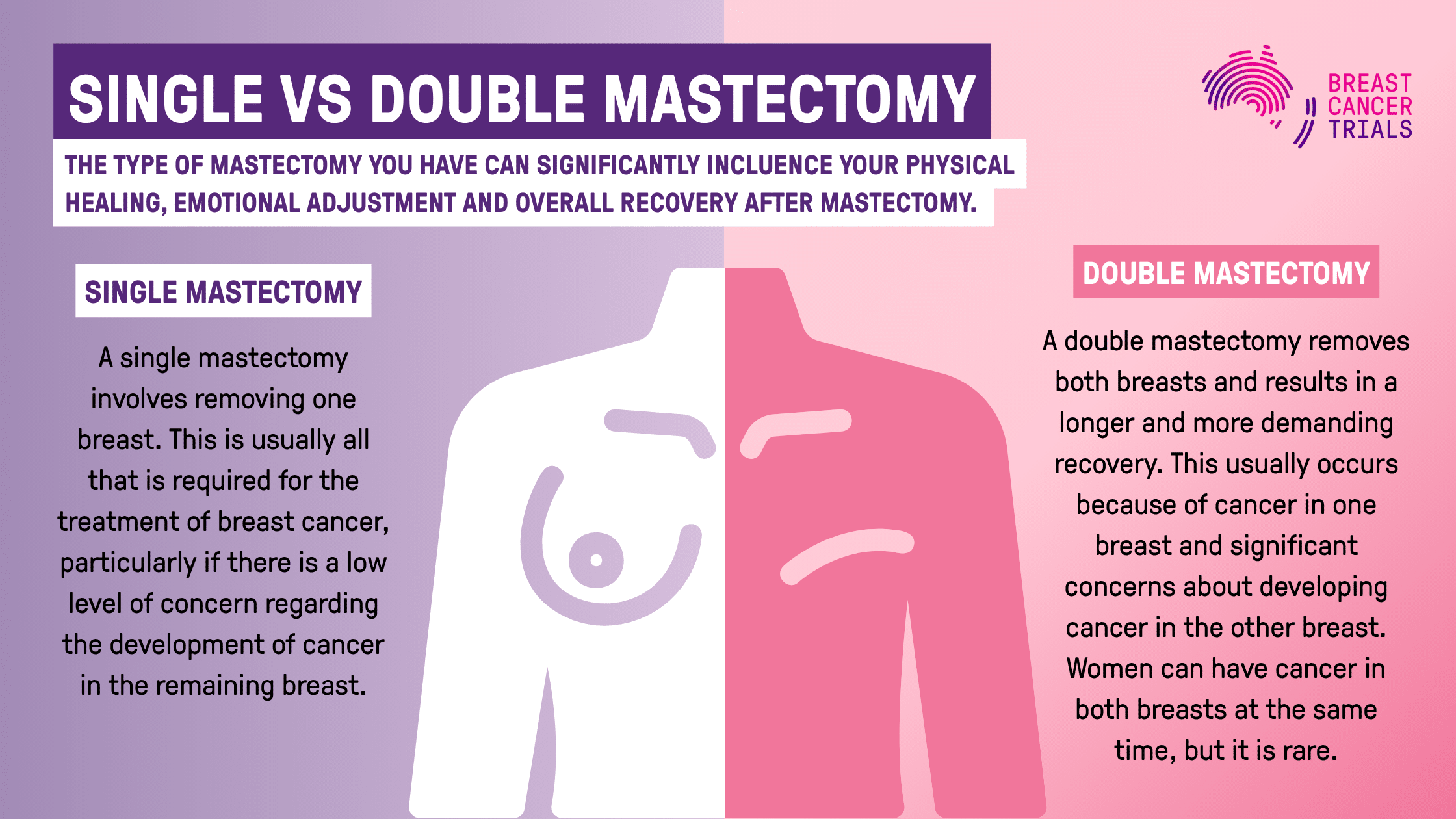
The type of mastectomy you have can significantly influence your physical healing, emotional adjustment, and overall recovery after mastectomy. Each surgical option has its own benefits, considerations, and timelines for getting back to everyday life. Understanding these differences can help you prepare for the days, weeks, and months following your operation.
Single vs. double mastectomy
Single mastectomy
A single mastectomy involves removing one breast. This is usually all that is required for treatment of breast cancer, particularly if there is a low level of concern regarding development of cancer in the remaining breast.
Double mastectomy
A double mastectomy removes both breasts and results in a longer and more demanding recovery. This usually occurs because of cancer in one breast and significant concerns about developing cancer in the other breast. Women can have breast cancer in both breasts at the same time, but it is rare.
Emotionally, some women find reassurance in removing both breasts, especially if they are at higher genetic risk, while others may need more time to adjust to the changes in their body.
Breast reconstruction options: with or without breast reconstruction
Your recovery will also vary depending on whether you choose reconstruction, the type of reconstruction performed and the timing of reconstruction.
No breast reconstruction (“going flat”)
No breast reconstruction, also known as flat closure and “going flat”, often results in:
- A shorter operation
- Fewer surgical sites (incisions)
- A generally quicker recovery from mastectomy
- Fewer risks related to implants or flap surgery
- Emotional recovery may take time as you adjust to a changed chest shape
Decisions to consider: reconstruction vs going flat
Choosing between reconstruction and going flat is a personal decision shaped by lifestyle, body image, and what feels right for you. Going flat offers a simpler surgery and recovery, which some women prefer, though adjusting to a flat chest can take time emotionally.
Reconstruction can help restore breast shape and support body confidence for some, but it usually involves more extensive surgery and a longer healing process. Speaking with your surgeon, GP or breast care nurse can help you understand which option best aligns with your goals and comfort.
Women who choose to ‘go flat’ also have non-surgical options including breast prostheses to recreate the shape of the breast without reconstruction. Prostheses are worn inside specialised bras and even swimwear and come in a range of sizes and weights that can be customised to the woman. There are government subsidies towards the cost of prostheses.
Types of breast cancer reconstruction
There are 2 main types of reconstruction options, implant-based reconstruction and autologous flap reconstruction:
- Implant-based reconstruction (using silicone or saline implants)
- Autologous flap reconstruction (using tissue from another area of the body, such as the abdomen, back, or thighs)
Implant based reconstruction can sometimes require a tissue expander which is a temporary device placed under the chest muscle or skin that is gradually filled with saline or air to allow the tissue to stretch prior to insertion of the permanent implant.
Flap reconstruction has a longer recovery time as this surgery involves removing tissue from a separate part of the body (e.g abdomen in a DIEP flap) and attaching it to the chest wall to create the new breast shape. This is more complicated surgery which can involve additional drains and more complex wound care, extend hospital stays, and restrict activity for several weeks.
Single verses double reconstruction
Recovery time for bilateral reconstruction after double mastectomy is typically longer than going flat or having a single reconstruction after mastectomy on one side only. This is because surgery is required to both sides of the chest which means more time needed for healing and return to normal mobility and function.
Immediate breast reconstruction
Immediate reconstruction is performed during the same surgery as your mastectomy. Whilst this means that both the mastectomy and reconstruction are performed in the one surgery, it increases surgery time which may not be safe for patients with poorer general health. Immediate reconstruction also increases healing time which is not always ideal for more aggressive cancers that require treatment with post-operative chemotherapy. Some breast cancers also require post-operative radiation treatment which is preferrable to give prior to reconstruction.
Delayed reconstruction
Some women choose reconstruction months or years later.
- A shorter initial mastectomy recovery period
- More time to consider reconstruction options
- Flexibility if further treatment (like radiation) is needed
Skin-sparing and nipple-sparing mastectomies
Skin-sparing and nipple-sparing mastectomies are specialised surgical techniques designed to preserve as much of the breast’s natural appearance as possible.
- Skin-sparing mastectomy removes the breast tissue but keeps most of the overlying breast skin.
- Nipple-sparing mastectomy goes a step further by also preserving the nipple and areola, if it is safe to do so based on the location and type of cancer.
These approaches are often used when a woman chooses immediate reconstruction because the preserved skin and sometimes the nipple, provides a natural envelope for an implant or flap, resulting in a more natural-looking outcome.
Patient perspectives: deciding on a mastectomy
“Don’t be afraid to ask questions even the ones that feel small or repetitive. Appointments can be overwhelming, and it’s easy to forget what you wanted to ask once you’re in the room. Writing a list beforehand and taking it with you can be incredibly helpful. If possible, bring someone along to your appointment. These conversations can be emotionally charged, and having another person there to listen, absorb the information, and help relay it back to you later when you have the mental space can make a difference. Your medical team is there to support you, and advocating for yourself isn’t being difficult; it’s being informed.”– Katrina
“I wish I knew before my mastectomy not to get caught up with buying multiple bras, in built bra tank tops and swimmers and then an array of pillows to assist post surgery. It all adds up financially and I know everyone is different, but for me it wasn’t necessary. It was panic buying in my case”. – Kate
“After two years, I had a breast reconstruction. This was the best decision. Not only did the reconstruction make me feel physically whole again, it also improved my self-confidence and emotional wellbeing. I had completely underestimated how much a reconstruction would help me heal mentally and emotionally. So, with the benefit of hindsight, I would have planned my reconstruction as early as practical.” – Merryn
Read Merryn’s full story here.
I wish I knew before my mastectomy that I didn’t have to rush the decision about reconstruction. And I did feel that it was a rushed decision. It’s difficult making that decision about reconstruction when you have no hair, feeling like a drugged up alien and when you’re exhausted and emotional. I found lots of resources supporting reconstruction but little about what it’s like to either wait after all treatment is completed before making a decision or about being flat permanently. I knew what the scarring would look like and a discussion about external prosthesis but little about the emotional aspect of being flat. And that’s what I needed to know, how other women dealt with the emotional side. – Kate
These stories highlight the importance of preparing for physical, emotional, and lifestyle changes.
Sources:
https://www.bcna.org.au/resources/articles/breast-cancer-in-men
https://nbcf.org.au/about-breast-cancer/further-information-on-breast-cancer/breast-cancer-in-men/
https://www.cancer.org.au/types-of-cancer/breast-cancer/breast-cancer-in-men
Join Our Free Q&A Webinars
Don’t miss an opportunity to stay informed about the latest in breast cancer research and care. Join our FREE Q&A webinars, where we cover important topics including whether more young women are being diagnosed with breast cancer.
Stay Connected with Breast Cancer Trials
Don’t miss an opportunity to stay informed about the latest in breast cancer research and care. Sign up to our researcher’s newsletter via the form below to stay up to date.